

As sustainability becomes a priority in construction and interior design, builders and designers are searching for building materials that combine performance, durability, and environmental responsibility. One emerging solution is Palm Strand Board (PSB®) — the region’s most sustainable building material made from upcycled palm fronds.
But how does PSB® wooden board perform compared with traditional materials such as MDF, plywood, and particleboard?
A recent independent study conducted by Abu Dhabi University provides valuable insights. The research evaluated the mechanical strength, thermal performance, and moisture behavior of PSB® compared with conventional engineered wood products.
The results show that PSB® is not only a sustainable alternative but also a strong competitor to traditional boards in multiple performance areas. PSB®
What Is Palm Strand Board (PSB®)?
Palm Strand Board (PSB®) is an engineered wooden board made from pruned palm fronds. The palm fibers are processed and pressed into strong panels using adhesives and high pressure, creating a durable board suitable for furniture, interior fit-outs, and construction applications.
Unlike traditional boards that rely heavily on timber, PSB® utilizes agricultural byproduct from date palm trees, turning a common regional by-product into a high-value building material.
According to the Abu Dhabi University research, PSB® demonstrates excellent mechanical and physical properties, making it a viable alternative to imported wood-based boards.
Independent Research Comparing PSB®, MDF, and Particleboard
The Abu Dhabi University study titled “The Significance and Applications of Recycled Palm Waste Leaves: Advancing Sustainable Development in Architecture and Interior Design” analyzed three engineered board types:
- Palm Strand Board (PSB®)
- Medium Density Fibreboard (MDF)
- Particleboard (chipboard)
Researchers conducted multiple laboratory tests, including:
- Compression strength tests
- Thermal conductivity tests
- Surface wettability analysis
These tests evaluated how each material performs under structural load, heat transfer, and moisture exposure.
1. Strength and Structural Performance
Structural strength is a critical factor when choosing engineered boards for furniture, partitions, cabinetry, and construction components.
In compression testing using an ELE-3000 compressive testing machine, the study compared the behavior of 18mm boards of PSB®, MDF, and particleboard under identical conditions.
The results showed:
- PSB® reached approximately 15 mm compression
- MDF reached about 9 mm compression
- Particleboard reached around 10 mm compression
These findings demonstrate that PSB® maintains strong load resistance and structural integrity, making it highly suitable for demanding interior applications.
2. Thermal Performance and Insulation
Thermal conductivity measures how easily heat passes through a material. Lower conductivity means better insulation performance, which is valuable in construction and interior architecture.
The Abu Dhabi University research found that:
- PSB® showed the lowest thermal conductivity
- Particleboard showed moderate performance
- MDF exhibited higher heat transfer
This means PSB® performs better as an insulating material, helping improve energy efficiency in buildings.
This characteristic makes PSB® ideal for applications such as:
- Interior wall panels
- Decorative wall systems
- Furniture structures
- Architectural installations
- Partition walls and office cubicles
- Ceiling panels
- Cabinetry and joinery
- Fire-rated and non-fire rated door cores
- Retail displays and fixtures
- Acoustic panels
- Trusses and structural frameworks
- I-beams and load-bearing components
3. Moisture Interaction and Surface Behavior
Moisture exposure can significantly affect the durability of engineered boards. To evaluate this, researchers conducted wettability tests using water contact angles.
The contact angle measures how water spreads on a surface:

A higher contact angle generally indicates less water absorption and better moisture resistance.
The results suggest that PSB® wooden board absorbs less moisture than many traditional boards, helping maintain durability and surface stability in humid environments.
4. Density and Material Stability
The research categorized PSB® within OSB Type 3 classification, with an average density between 700–800 kg/m³.
This density is:
- Higher than particleboard
- Comparable to high-quality structural boards
- Suitable for furniture and architectural applications
Higher density contributes to better strength, durability, and dimensional stability.
PSB® vs MDF vs Particleboard: Quick Comparison

Sustainability: A Circular Material Solution
One of the most significant advantages of PSB® is its environmental impact.
Palm trees produce large amounts of agricultural byproduct every year. Traditionally, this waste is burned or discarded. By converting palm biomass into engineered wooden boards, PSB® supports:
- Waste reduction
- Local resource utilization
- Lower carbon emissions
- Reduced reliance on imported timber
The Abu Dhabi University study highlights that using palm biomass in engineered wooden boards can reduce environmental impact while promoting sustainable construction practices.
Real-World Applications of Palm Strand Board
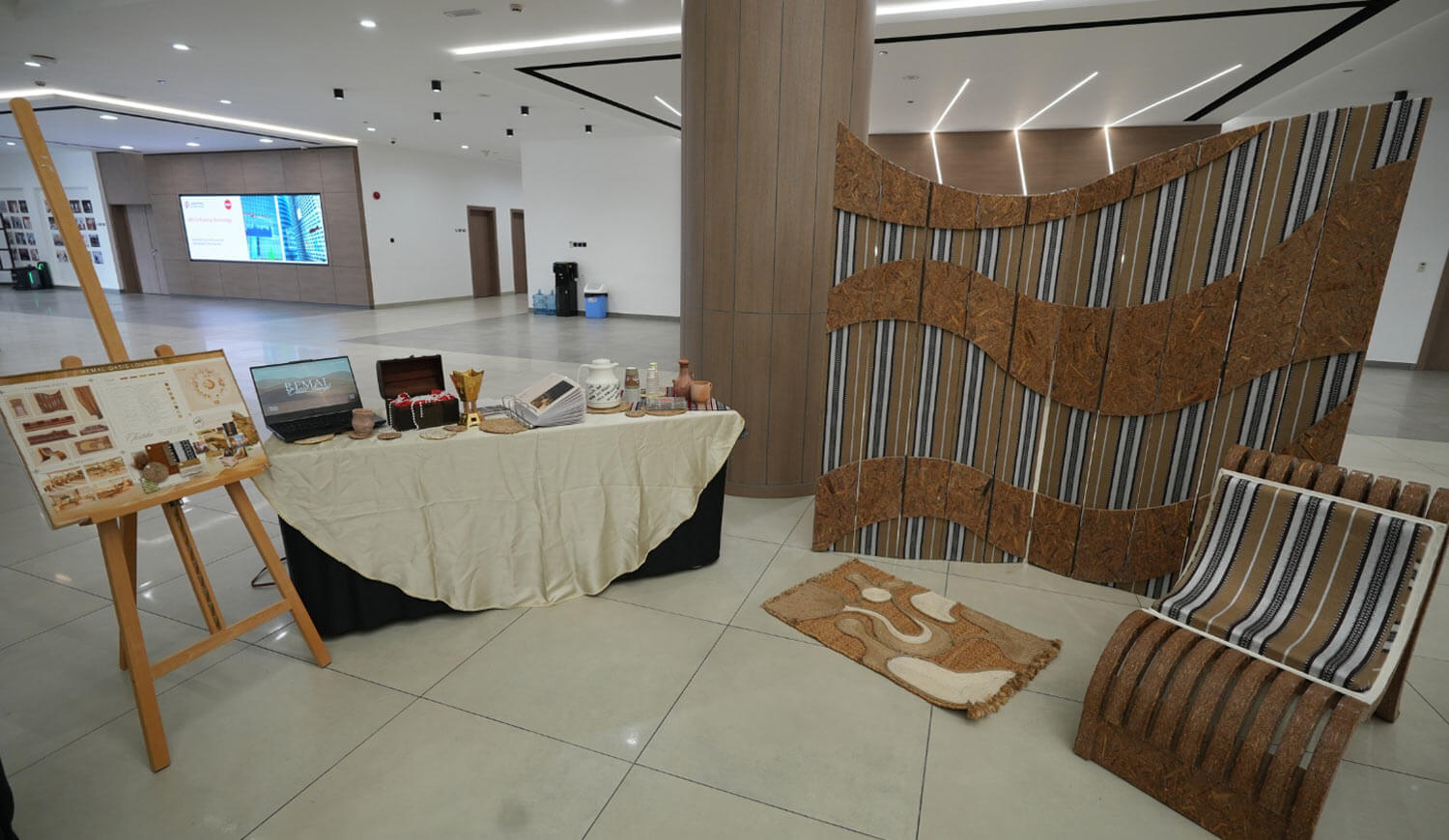
The research also demonstrated real applications by creating interior design furniture and partitions using PSB® boards.
Students at Abu Dhabi University successfully built:
· Interior partitions
· Decorative panels
· Furniture pieces
· Architectural installations
These prototypes confirmed that PSB® is both structurally reliable and visually suitable for modern design applications.
Why Palm Strand Board Is the Future of Sustainable Panels
Abu Dhabi University’s research shows that sustainable engineered boards are on par with traditional wood products in both practicality and performance.
Palm Strand Board delivers:
- Strong structural performance
- Improved insulation capability
- Better moisture interaction
- Sustainable raw materials
For architects, designers, and manufacturers looking to reduce environmental impact without compromising quality, PSB® represents a new generation of engineered wooden boards.
Interested in sustainable engineered boards? Explore how DesertBoard Palm Strand Boards (PSB®) are transforming construction and interior design with eco-friendly performance here.


