

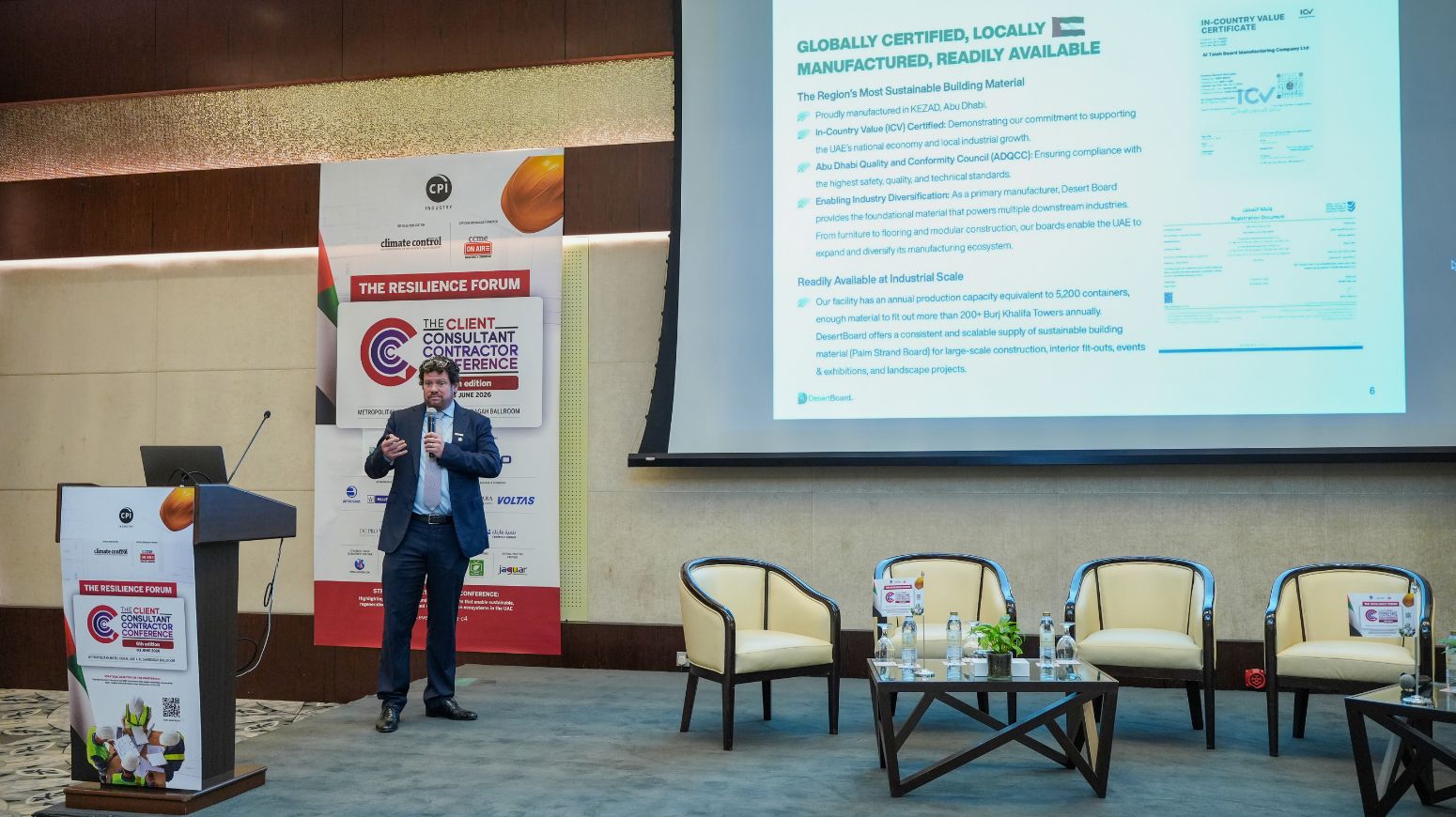
The sixth edition of The Client, Consultant, Contractor Conference, held on July 3 in Dubai under the theme ‘The Resilience Forum’, brought together industry stakeholders to explore how the built environment can respond to growing geopolitical, environmental and economic challenges.
Moving beyond the conference’s traditional focus on energy efficiency, water-use optimisation and Indoor Environmental Quality (IEQ), this year’s discussions examined the broader concept of resilience, with particular emphasis on decentralisation, self-reliance and the ability of UAE urban ecosystems to adapt to emerging challenges.
Among the industry voices contributing to the discussion was Kamal Farah, Director at DesertBoard, who highlighted the role of locally manufactured, sustainable building materials in reducing the environmental impact of construction.
Following a technical presentation at the conference, Farah introduced Palm Strand Board (PSB®), DesertBoard’s engineered wooden board manufactured in the UAE using upcycled date palm fronds. He positioned palm strand board as an example of how local resources and industrial innovation can support more sustainable and resilient built environments.
Farah noted that 39% of global emissions are attributable to the built environment, underscoring the need for material choices that can reduce emissions across a building’s lifecycle. “We can reduce 50% of the building’s lifecycle emissions by using sustainable materials,” he said, while also highlighting the contribution of deforestation and forest degradation to global greenhouse gas emissions.
A key aspect of his presentation was the importance of locally manufactured, low-emission materials. Farah explained that PSB® is manufactured with zero formaldehyde content, while highlighting the product’s range of certifications and approvals, including an Environmental Product Declaration (EPD), In-Country Value certification, Abu Dhabi Quality and Conformity Council approval and Emirates Safety Laboratory fire-rating accreditation. He also noted that PSB® has gained Class B fire-rated wall panel certification.
Farah further demonstrated the material’s carbon impact through its application in real-world projects. Referencing one of DesertBoard’s joinery customers, Abanos, he stated that the company had sequestered more than four million tonnes of CO₂ through the use of PSB® in its projects over a period of one and a half years.
At full manufacturing capacity, DesertBoard can produce enough PSB® annually to fill approximately 5,200 containers, with the capacity equivalent to fitting out more than 200 towers the size of the Burj Khalifa. Each cubic metre of PSB® also stores 1,430 kilograms of biogenic carbon, further demonstrating the material’s potential contribution to lower-carbon construction.
Concluding his address, Farah connected PSB® to UN Sustainable Development Goal 11: Sustainable Cities and Communities, describing the product as a modern, industrial evolution of the traditional practice of using date palm fronds to construct shelters.
His participation at The Resilience Forum reinforced a central theme of the conference: building resilience in the UAE’s urban environment requires not only efficient systems and infrastructure, but also greater reliance on local resources, manufacturing capabilities and sustainable material innovation.
Read the full Post-Event Report: The Resilience Forum – Post-Event Report


